
Being good is not enough if nobody can find you
Basketball is full of talent.
Every day, young athletes step onto the court, work on their game, compete with intensity, and try to build something meaningful for their future.
Some are strong scorers.
Some are reliable playmakers.
Some are elite defenders.
Some are developing bigs.
Some are versatile wings who can impact the game in different ways.
But there is one problem many athletes face: being good does not automatically mean being visible.
A player can have a great season, perform well in tournaments, improve physically, earn minutes, show leadership, and still remain difficult to evaluate if their information is not organized in one clear place.
For clubs, scouts, agents, and sports operators, scattered information creates friction.
A video clip is useful.
A social media post can help.
A highlight reel can catch attention.
But a basketball player is not just one play.
A serious evaluation needs context.
Social media shows moments. A profile shows the athlete.
Many basketball players rely almost entirely on social media for visibility.
An Instagram clip.
A TikTok highlight.
A game photo.
A short reel after a strong performance.
These things can help, but they are not enough.
Social media shows fragments. TalentLix is built to show the full profile.
That difference matters.
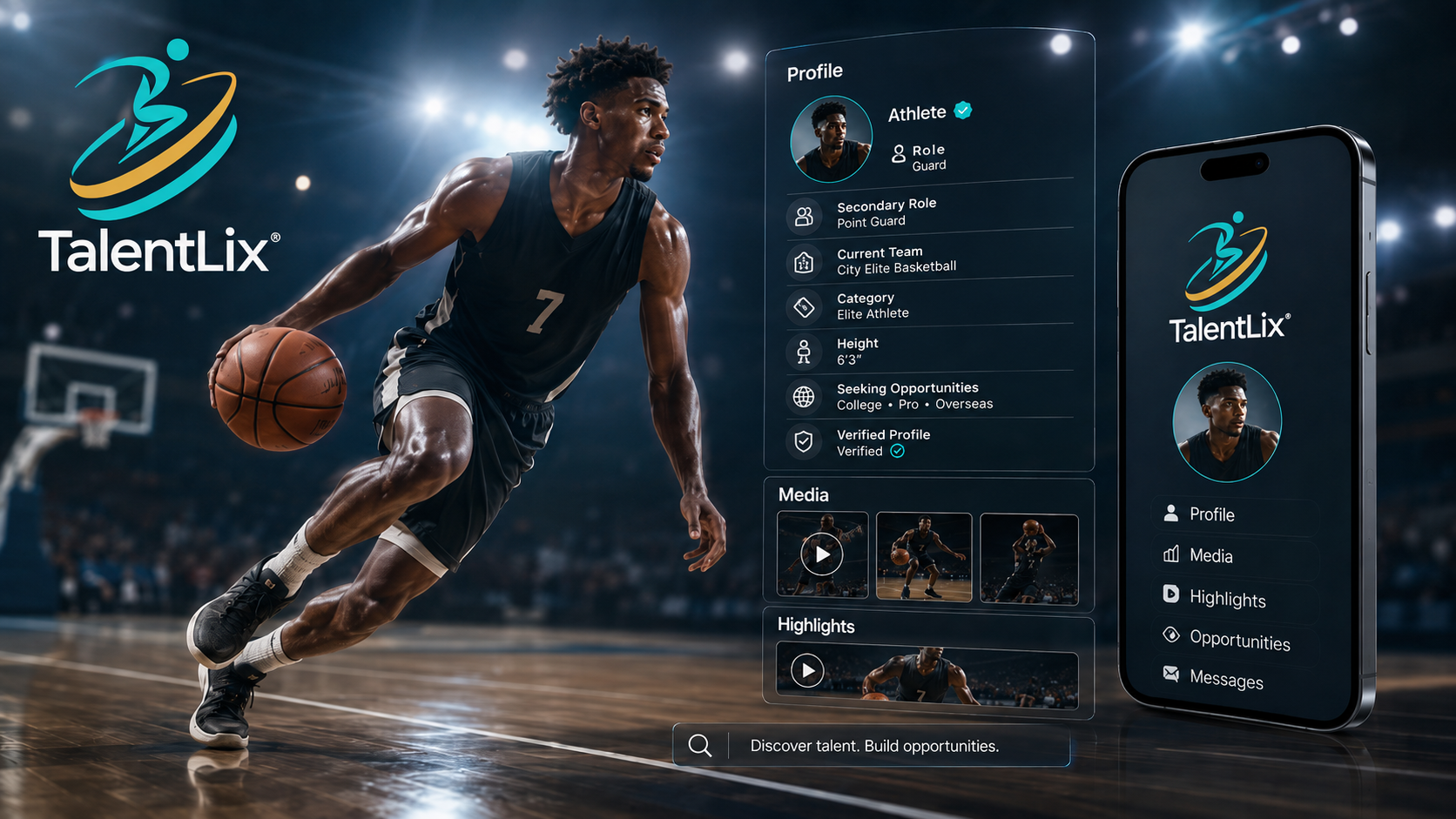
A club or scout does not only need to see a dunk, a three-pointer, a crossover, or a block. They need to understand who the athlete is:
- age;
- height;
- main role;
- secondary role;
- current team;
- category or level;
- previous experience;
- availability;
- media content;
- athletic profile;
- achievements;
- updated contact and visibility status.
In basketball, these details are not secondary. They are part of how an athlete is understood.
A point guard is evaluated differently from a center.
A young prospect is evaluated differently from a senior player.
A player looking for a new team needs to make that clear.
An athlete open to opportunities in other regions or countries needs a structured way to show it.
If this information is spread across messages, links, chats, posts, and old videos, the athlete loses value in the eyes of those trying to evaluate them.
Basketball evaluation needs context
In basketball, context changes everything.
A 15-year-old guard is not evaluated the same way as an 18-year-old forward.
A player competing at a high youth level is not read the same way as a player developing in a local or regional environment.
A center with strong physical upside tells a different story from a smaller guard with elite decision-making.
A player with limited exposure may still have serious potential if the right information is available.
That is why visibility must be structured.
It is not enough to say: “I can play.”
An athlete needs to show:
who they are, where they play, what role they have, how they are developing, and what kind of opportunity they are looking for.
This does not replace what happens on the court.
The game remains the game.
But a clear profile helps the right people understand the athlete faster and more seriously.
TalentLix brings order to athlete visibility
TalentLix allows basketball athletes to create a personal sports profile designed to be discovered and viewed by sports operators.
It is not just another social network.
It is not built for random content.
It is not based on empty promises.
TalentLix is built to give athletes a clearer, more professional, and more structured way to present themselves.
For a basketball player, this means having one place to organize:
- personal and sports information;
- basketball role and category;
- current team;
- previous experience;
- availability for new opportunities;
- profile photo;
- highlights;
- game videos;
- physical data;
- achievements and awards;
- social links;
- profile completion and visibility status.
Everything becomes easier to read, easier to update, and easier for clubs or scouts to evaluate.
Visibility does not replace work. It supports it.
Let’s be clear: no platform can turn an athlete into a professional player by itself.
There are no shortcuts.
You still have to train.
You still have to compete.
You still have to improve.
You still have to accept pressure.
You still have to prove yourself in real games.
But in modern basketball, performance alone is not always enough.
If your journey is invisible, your opportunities become harder to reach.
Visibility does not replace talent.
Visibility helps talent get found.
That is the point.
A structured athlete profile does not guarantee success. But it can help reduce confusion, create a better first impression, and make it easier for the right people to understand your potential.
Why athletes should start early
Many players wait for the “right moment.”
They wait for the big tournament.
They wait for someone to notice them.
They wait for a coach, agent, or contact to make the first move.
They wait until an opportunity appears.
But often, the right moment comes only for athletes who are already prepared.
Building a profile early means you do not have to rush when someone asks for your information.
It means your sports journey already has a clear place.
It means clubs, scouts, and operators can understand your background faster.
It means your visibility does not depend only on a single post, a single highlight, or a single person remembering your name.
If you play basketball, your journey deserves to be seen
Basketball is competitive everywhere.
There are many athletes, many teams, many levels, and many stories. In that environment, being organized and visible is not a small detail. It is an advantage.
TalentLix gives basketball athletes a simple way to create a profile, update it over time, and make their sports journey easier to discover.
Do not let scattered posts, isolated clips, or old messages speak for you.
Create your athlete profile on TalentLix and make your basketball journey more visible, clearer, and more professional.