
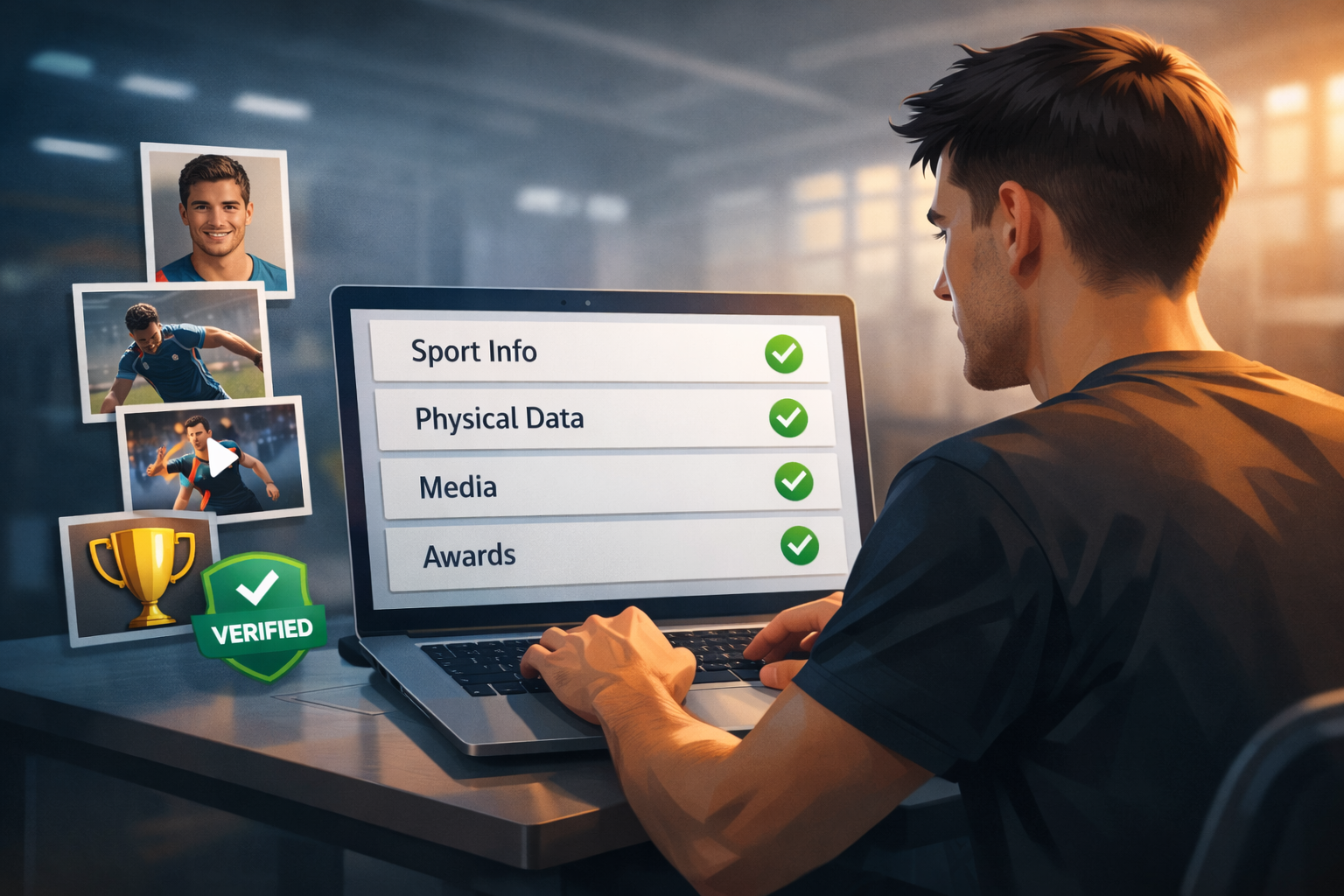
Why profile completion is not cosmetic
On TalentLix, your profile is not a “bio.” It’s a scouting file.
Decision-makers don’t want to “figure you out.” They want to:
-
filter you in/out fast
-
understand your role and level
-
see recent context
-
verify credibility
-
contact you with confidence
If your profile is incomplete, the platform can’t surface you properly—and operators won’t waste time asking basic questions you should have already answered.
1) Sport Info: the core that makes you searchable
This is the foundation of how you appear in searches and shortlists. At minimum, make sure you complete the baseline fields from onboarding (sport + category), then refine everything else.
Key fields and how to fill them
-
Sport: choose the exact sport you play.
-
Category: pick the correct level/age bracket.
-
Years of experience (optional): keep it realistic. Don’t inflate it—experienced scouts will spot nonsense instantly.
Availability: “Seeking team” is a major signal
If you’re actually open to opportunities, this is one of the highest-impact switches in your profile.
-
Seeking team: only turn it on if you mean it.
-
Preferred regions: where you’re realistically open to playing or relocating.
-
Trial window (optional but powerful): add a start and end date when you can attend trials. Keep it accurate and up to date.
Contract and representation: clarity beats mystery
-
Contract status / end date (optional): if you have a contract, state it clearly. If you don’t, don’t pretend.
-
Representation: if you’re represented, list it correctly. If you’re not represented, don’t leave old agent names in the profile—clean data builds trust.
Career history: your season timeline (high value)
Your season history is one of the most useful sections for scouts because it answers “where has this athlete actually played?” fast.
Fill in:
-
team name
-
season
-
category/level
-
role (where applicable)
-
notes that add context (short, factual)
If you only do one “extra” thing beyond onboarding: complete your season history.
2) Physical Data: optional, but it differentiates serious athletes
This section isn’t mandatory, but it can strongly increase trust and clarity—if you’re honest.
What you can add
Physical snapshot
-
height
-
weight
-
measurement date
-
dominance/laterality (right/left, etc.)
Performance tests (only if real)
Use tests you actually measured. Examples:
-
sprint time (e.g., 10m)
-
vertical jump
-
plank/core endurance
-
strength indicators
-
endurance benchmarks
The rule: don’t fake metrics
If you type random numbers, you either look unreliable or you’ll get questioned the moment someone takes you seriously. If you can’t prove it, don’t write it. Simple.
3) Media: photos, intro, highlights, game videos — curated, not chaotic
Media is where most profiles fail because athletes upload noise. Your goal is not to impress casual fans. Your goal is to make evaluation easy.
What to upload
Featured media (first impression)
-
1 clean headshot: face clear, good light, neutral background
-
2 action photos: show role, intensity, body position
Intro video (optional, high impact)
-
keep it short (30–90 seconds)
-
say who you are, your role, your current level, what you’re seeking
-
no cringe editing, no fake hype, no music copyright problems
Highlights (be ruthless)
Highlights should show three different things, not three copies of the same clip style:
-
fundamentals in your role (what you do every game)
-
decision-making (reads, timing, positioning)
-
ceiling moments (speed/power/skill)
Game videos (where serious scouts decide)
Full game footage (or long segments) adds credibility because it shows consistency, not just best moments.
For each game video, add proper context when possible:
-
opponent
-
competition
-
season
-
match date
If you only post highlights, some operators assume you’re hiding weaknesses. Game footage builds trust.
4) Awards & Recognitions: proof beats claims
Awards are optional, but they can add credibility fast—especially when supported.
What to include
-
award name/title
-
season
-
awarding entity
-
date
-
short description (what it was and why it mattered)
-
evidence (certificate/photo/link) if available
What not to do
-
don’t invent awards
-
don’t write vague “MVP” with no context
-
don’t attach useless screenshots that prove nothing
One real award with proof is worth ten empty claims.
How to complete your profile fast (practical checklist)
✅ Minimum that makes you searchable
-
sport + category
-
seeking team (accurate) + preferred regions (if relevant)
-
career seasons (at least current + last season)
✅ What makes you competitive
-
physical snapshot + a few real performance tests (only if measured)
-
featured headshot + 2 action photos
-
1 short intro + 2–3 curated highlights
-
a handful of recent game videos with context
-
1–3 awards with evidence when possible
✅ The rule that keeps everything credible
Update it. A stale profile looks abandoned. An updated profile looks serious.