
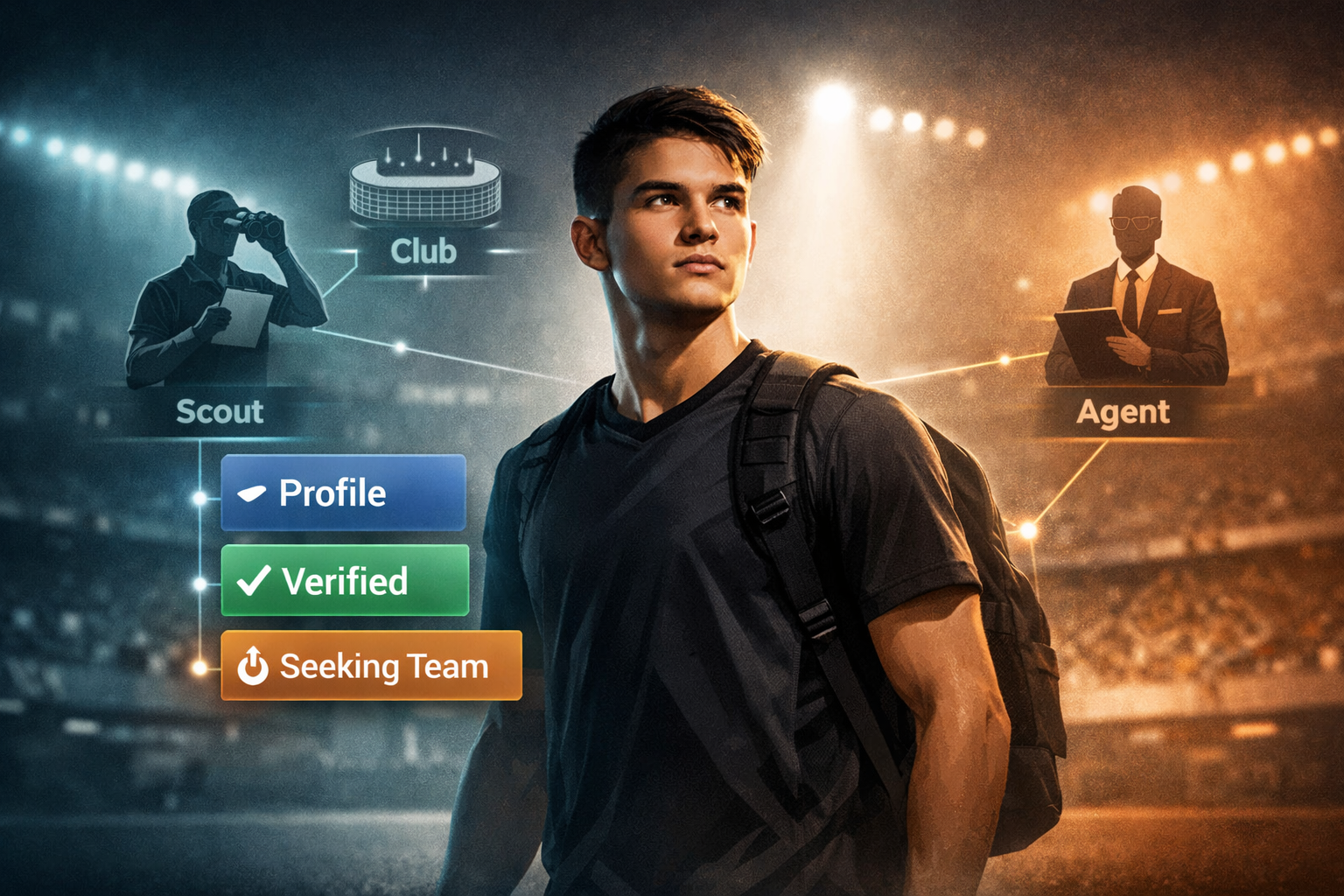
Visibility isn’t vanity. It’s access.
In sport, “talent” is not the finish line—it’s the entry ticket. The real separator is access: access to trials, academies, showcases, agents, clubs, scholarships, and the conversations that open doors.
Here’s the blunt truth: you can be good and still get nowhere if you’re not visible to the people who matter. Not your friends. Not your local followers. The people who make decisions: scouts, coaches, sporting directors, academies, agents, and clubs.
Visibility is not about ego. It’s about being discoverable, verifiable, and reachable at the exact moment someone is searching for an athlete like you.
The old system is still killing careers
Most athletes still rely on two broken systems:
Generic social media (Instagram, TikTok, YouTube, X)
Word-of-mouth (coaches, family networks, “someone who knows someone”)
Both can help. But both have a hard ceiling.
Why generic social media isn’t enough
Social platforms are built for entertainment, not recruitment. Their algorithms optimize for watch time, reactions, trends, virality, aesthetics.
That’s fine—until you realize scouting needs the opposite: structured athlete data, filters (age, role, nationality, category), verified identity, real performance context, contact pathways, reliability signals.
A highlight reel can get attention. But it rarely answers what decision-makers need:
Who are you, exactly?
Are you real and eligible?
What role do you play, and at what level?
Where are you based?
Are you seeking a team?
Can I contact you now?
Is this athlete serious or just posting clips?
If the answers aren’t immediate, you get skipped.
Why word-of-mouth can trap you forever
Word-of-mouth works—inside your circle. The problem is that your circle is limited.
If you’re not already in a strong academy pipeline, or connected to influential staff, word-of-mouth becomes a closed loop: the same contacts, the same local reach, the same “maybe next year,” the same missed timing.
And timing matters. Trials open and close. Injuries happen. Rosters change. Clubs search fast. If you’re not visible at the moment of need, you don’t exist.
How recruitment works in the real world (today)
Clubs and agents don’t have unlimited time. They use systems. They filter. They shortlist. They prioritize athletes who are easy to verify and easy to contact.
Modern recruitment is basically a pipeline:
Discovery (search + scouting + referrals)
Screening (identity, age, role, level, availability)
Shortlist (save profiles, compare, share internally)
Contact (message, request details, schedule a call/trial)
Decision (trial, contract, academy placement, representation)
Generic social media fits poorly into this pipeline because it’s chaotic, unstructured, and hard to trust.
What decision-makers really want is simple: a database of athletes, structured profiles, filters and search, verified identities, direct messaging, fast shortlisting.
That is exactly the gap TalentLix is built to fill.
What TalentLix does differently (and why it matters)
TalentLix is not “another social network.” It’s a professional discovery platform for athletes, designed around how clubs and agents actually operate.
1) Your profile becomes searchable—not just “posted”
On TalentLix, your profile isn’t just a page people stumble upon. It’s a structured asset that can be found through real scouting logic: sport, role, category, age, nationality, location, availability (“seeking team”), and other discovery signals.
This turns you from “content” into a candidate.
2) Trust is built in (verification changes everything)
In recruitment, trust is currency. TalentLix is designed around identity and credibility: verified phone, identity checks (where required), consistent profile structure, data that matches a real person.
A verified athlete is safer to contact and easier to shortlist. That alone increases your chances.
3) Direct connection beats passive exposure
Getting “views” is not the same as getting opportunities.
TalentLix is built to enable direct contact from operators (clubs/agents/scouts), messaging designed for recruitment (not comments), and a clean separation between professional profile and optional “social” noise.
Less distraction, more outcomes.
4) You’re not competing with memes and influencers
On social platforms, an athlete competes against everything: comedy, lifestyle creators, celebrities, trends, drama.
On TalentLix, you compete only against other athletes—inside a context where people are there to scout.
5) Your “seriousness” becomes visible
Decision-makers notice patterns: complete profiles, regular updates, responsiveness, clear goals, published status, strong media + accurate context.
TalentLix allows those signals to exist. You’re not just “a clip.” You’re a professional presence.
The real advantage: being findable at the right moment
Opportunities often appear suddenly: a player gets injured, a roster slot opens, a team needs a specific role, an agent is asked to fill a gap, a club expands an academy group.
In those moments, scouts don’t scroll randomly. They search. They filter. They shortlist.
If your profile is unpublished, incomplete, not searchable, not credible, or impossible to contact, you’re out—even if you’re good.
TalentLix is designed to make sure that when those moments happen, you’re in the results.
What athletes should stop doing (if they want real opportunities)
Be honest with yourself. If you want to be recruited, stop relying on random posting without structure, “one day someone will see me,” collecting followers as a plan, waiting for a coach to push you forever, hoping a viral video becomes a career strategy.
None of that is a system. It’s gambling.
A system looks like: a verified identity, a complete and searchable profile, updated sports information, clean media and context, clear availability, direct contact pathways.
That’s what TalentLix is built for.
Practical checklist: how to use TalentLix to increase opportunities
Complete your base profile. Don’t leave gaps. Missing data makes you unfilterable.
Verify what needs to be verified. Trust is not optional when money, contracts, and minors are involved.
Upload media that scouts can actually evaluate. Not just “best moves.” Include game context, role clarity, and consistency.
Use “seeking team” and keep it accurate. If you’re available, say it. If you’re not, update it.
Update your profile regularly. Stale profiles look abandoned. Active profiles look serious.
Be reachable and respond fast. In recruitment, slow response = lost opportunity.
Final reality check
Your talent is real. But talent without visibility is wasted potential.
Generic social media can help—but it’s noisy, unstructured, and unreliable for scouting. Word-of-mouth can help—but it can trap you in a limited bubble forever.
TalentLix exists to turn visibility into something practical: searchable, credible, professional, and connected directly to the people who create opportunities.
If you want to be discovered, stop hoping and start being discoverable.